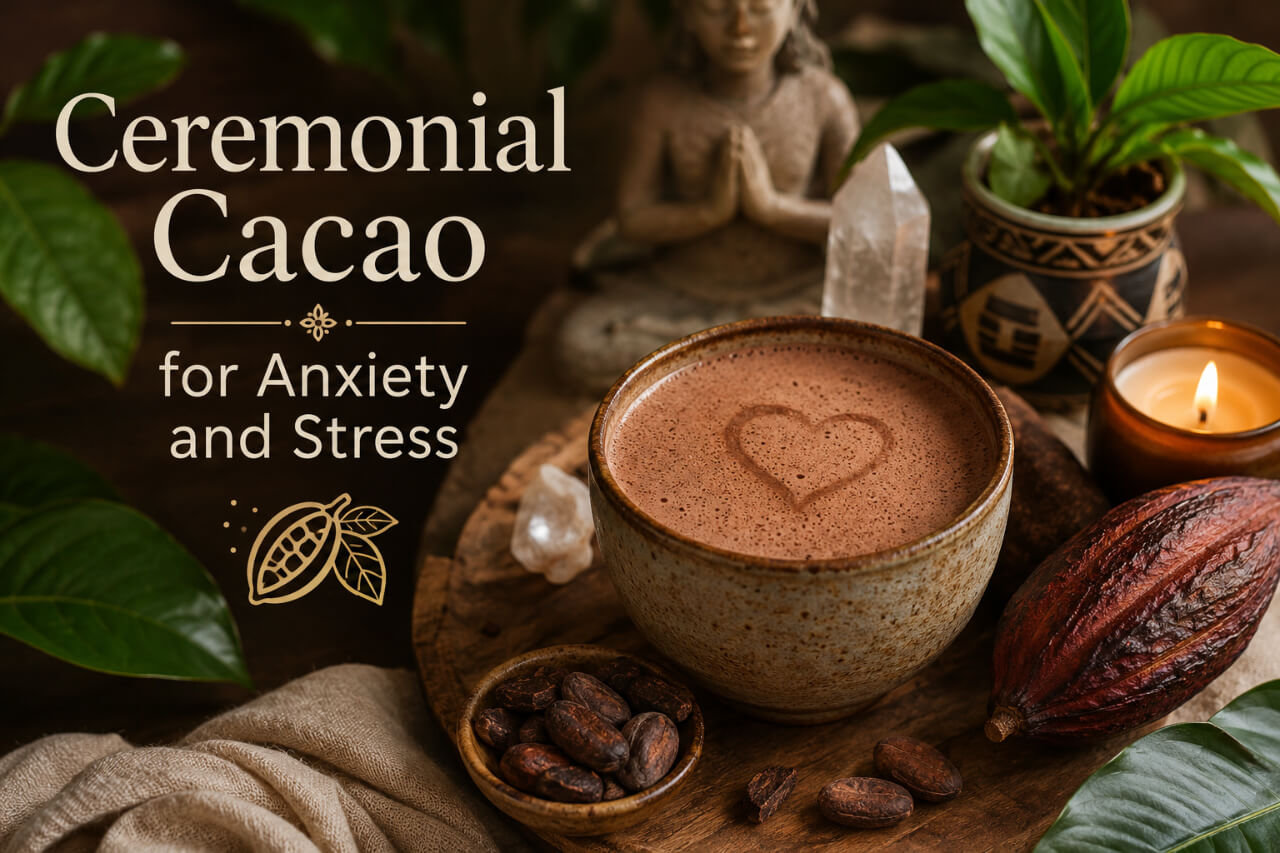
A cacao ceremony sounds more intimidating than it is. Read enough guides on the topic and you’ll picture yourself sitting cross-legged on a floor cushion surrounded by crystals, burning palo santo, speaking to the spirit of the cacao plant while a drum circle plays in the background.
That’s one version. It’s a legitimate one with deep indigenous roots. But it’s not the only version — and it’s not the version most people searching “cacao ceremony at home” are actually looking for.
What most people want is simpler and more honest: a structured practice that turns the act of preparing and drinking ceremonial cacao into something meaningful. A container for intention, reflection, and focused inner attention. A morning ritual that does something for your mind and your day that simply making a hot drink does not.
You don’t need to believe in plant spirits to benefit from the structure of ceremony. You don’t need crystals, a singing bowl, or to burn anything. What you need is good cacao, clear intention, and the willingness to be present — really present — for 30 to 90 minutes.
This guide covers everything: what a cacao ceremony actually is and why it works, five distinct ceremony formats mapped to different lifestyles, a full step-by-step structure you can follow at home, 40 specific journal prompts, how to run a simple group ceremony, and the most common mistakes beginners make. By the end you’ll be equipped to run your first home ceremony this week.
What a Cacao Ceremony Actually Is
The word “ceremony” carries weight that can feel exclusionary. Let’s define it plainly.
A cacao ceremony is a structured practice of drinking ceremonial-grade cacao intentionally — with a defined beginning, a period of focused inner work (meditation, journaling, creative practice, or simple presence), and a conscious closing. It distinguishes itself from simply making and drinking cacao by the presence of intention, structure, and attention.
That’s the core of it. Everything else — the candles, the music, the invocations, the group sharing — is context that enhances the container but isn’t the container itself.
The Historical Roots (In Brief)
Cacao’s ceremonial use dates to approximately 1,500 BCE with the Olmec civilization in present-day southern Mexico, who are believed to be the first to cultivate and ritually consume cacao. The Maya elevated it to genuine sacredness — the word ka’kau appears in ancient Mayan texts alongside depictions of gods pouring cacao from great heights to create the characteristic frothy drink, and the genus name Theobroma cacao translates directly as “food of the gods.” Cacao was consumed at Mayan weddings, funerals, royal ceremonies, and rites of passage.
The Aztecs inherited and elaborated this tradition. Cacao beans were so valued they functioned as currency — one bean could buy a tamale, a hundred might get you a turkey. Only priests, warriors, and nobility typically drank it.
The modern ceremonial cacao revival, which gained significant momentum in the late 20th century through figures like Keith Wilson (known as “The Cacao Shaman”) working with Mayan communities in Guatemala, draws from these traditions while adapting them for a contemporary, globally diverse audience.
This history matters not because you must engage with it spiritually, but because it explains why the structure of ceremony works even for entirely secular practitioners — humans have been using structured, intentional consumption of this specific plant for over 3,000 years. The practice has survived because it produces something real.
Why It Works: The Science Behind the Ceremony
This is the section that separates this guide from every spiritual-leaning alternative, and it matters for the skeptics, the scientists, and the pragmatists in the room.
Ceremonial cacao works in ceremony for the same reasons it works as a daily drink — with one important difference: the ceremonial context maximises the effect of every compound.
Theobromine’s role: A 35–42g ceremonial dose delivers approximately 295–355mg of theobromine — a cardiovascular stimulant that widens blood vessels, increases heart rate gently, and produces a sustained, warm energy distinct from caffeine’s neurological jolt. The vasodilatory effect — literally more blood flow to the heart and brain — is documented in clinical literature (PMC3672386). In a ceremony context, this increased circulation arrives during a period of intentional stillness and focused attention. The result is a state that many practitioners and researchers describe as heightened emotional openness and increased interoceptive awareness — sensitivity to what’s happening inside your own body and mind.
Anandamide: Cacao contains anandamide — the endocannabinoid nicknamed the “bliss molecule” — along with enzyme inhibitors that slow its breakdown, prolonging its effect. While the oral bioavailability of anandamide is debated, its presence in ceremonial doses contributes to the characteristic mood lift that begins approximately 20–30 minutes after drinking.
Magnesium: A ceremonial dose of cacao delivers approximately 130mg of magnesium — roughly 30% of the daily requirement. Magnesium is directly involved in regulating the nervous system’s stress response and plays a role in GABA production (the brain’s primary inhibitory neurotransmitter, associated with calm). Many people are magnesium-deficient; a ceremonial dose addresses this in real time.
The intentional container: Research on mindfulness and meditation consistently shows that structured attention — setting a clear intention, then maintaining focused presence — produces measurable changes in cognitive function, emotional regulation, and creative output. A cacao ceremony combines the pharmacological effects of the plant with a structured attention practice. You’re not doing one thing; you’re doing two things simultaneously. That’s why it works better than just drinking cacao, and better than just meditating.
The skeptic’s honest summary: You don’t need to believe in anything beyond the above to benefit from a cacao ceremony. The compounds in the plant are real. The neurological effects of intentional attention are real. The combination of both, in a defined container, produces a reliably useful state for inner work. That’s sufficient.
What You Need Before Your First Ceremony
The Cacao
This is the non-negotiable. The quality of the cacao directly determines the quality of the ceremony. At a 35–42g ceremonial dose, you are depending on the theobromine, flavonoid, and mineral content of the paste to do real physiological work. Supermarket cocoa powder will not produce a ceremonial experience — it has been defatted and in most cases heavily processed, stripping the majority of the bioactive compounds you need.
What to look for:
- 100% pure cacao paste with no additives — ingredient list should contain one item
- Third-party heavy metal testing (cadmium and lead) with published results
- Single origin, ideally from a named farm or region
- Heirloom variety where possible (Arriba Nacional, Criollo, Trinitario)
Our recommended brand is Cacao Laboratory — Arriba Nacional heirloom paste from Ecuador’s Manabí province, Eurofins batch-tested with published results. The consistent theobromine profile matters for ceremony: you want predictable, reliable effects, not variation batch to batch. Read our full Cacao Laboratory review for complete details.
Ceremony dose: 35–42g. See our dosage guide for full guidance including contraindications — important reading before your first ceremony.
The Space
A ceremony space is simply any space you’ve made intentional. That might mean:
Minimal setup (10 minutes): Turn off your phone. Close the door. Move to a comfortable position — sitting, lying down, or whatever works for your body. That’s it. Ceremony is a state of attention, not a collection of objects.
Enhanced setup (30 minutes): Additionally: a lit candle (the visual anchor of an ongoing flame is genuinely useful for sustained attention), background music, a journal and pen within reach, any object that holds personal meaning to you.
Full setup (1 hour): Additionally: cleared and cleaned space, plants or natural objects, incense or essential oils for olfactory anchoring, a blanket for warmth as the theobromine arrives, a dedicated altar or focal point.
The practical truth: The minimum that meaningfully shifts a drink into a ceremony is: phone off, door closed, and a declared intention before you drink. Start there. Complexity is optional.
Equipment for Preparation
- Kitchen scale (accurate dosing is important at ceremonial quantities)
- High-speed blender or saucepan
- Temperature-controlled kettle or standard kettle (rest 2–3 minutes after boiling)
- Your favourite mug — one you set aside for ceremony use if possible
Full preparation instructions in our complete how to make ceremonial cacao guide.
The 5 Ceremony Formats — Choose Yours
Not all ceremonies serve the same purpose. Here are five distinct formats, each suited to a different context, intention, and available time.
Format 1: The Morning Ritual Ceremony (20–30 minutes)
Best for: Daily practice, coffee replacement, setting tone for the workday Dose: 28–35g
The lightest ceremony format — close to a mindful daily ritual rather than a deep ceremony experience. The focus is on clarity of intention for the day ahead, not deep inner work. Prepare your cacao, sit quietly for 5 minutes before drinking, state one clear intention for the day, drink with full attention (no phone, no reading), spend 5 minutes journaling before moving into your day. Repeatable every morning. Builds compound effect over weeks.
Format 2: The Solo Inner Work Ceremony (60–90 minutes)
Best for: Personal processing, emotional clarity, creative breakthroughs, life decisions Dose: 35–42g
The most commonly described “cacao ceremony” format. Full ceremonial dose, 60–90 minutes of dedicated inner time. Structured in five phases (detailed below). Best used weekly or bi-weekly rather than daily — the deeper dose at this frequency maintains sensitivity and respect for the experience.
Format 3: The Creative Ceremony (45–60 minutes)
Best for: Writers, artists, musicians, makers — anyone using cacao to support creative work Dose: 28–35g
Ceremony as a creative incubator. The intention here is not self-exploration but creative output. Set up your materials before you begin — canvas, instrument, notebook, whatever the work requires. Drink the cacao, sit with it for 10–15 minutes in silence (this is the most important part — resist the urge to start immediately), then work. The theobromine curve typically reaches its peak approximately 45–60 minutes after drinking, which is when the creative work deepens.
Format 4: The Couple or Partnership Ceremony (60–90 minutes)
Best for: Partners seeking deeper connection, difficult conversations, relationship intentions Dose: 28–35g each
Two people sharing a ceremony creates a genuinely distinctive experience. Prepare the cacao together. Share the ritual of drinking. Sit facing each other in silence for 10 minutes before speaking. Then take turns — one person shares without interruption while the other listens with full attention. No advice, no cross-talk, no fixing. Then reverse. This format is particularly powerful before significant relationship conversations or transitions.
Format 5: The Group Ceremony (2–6 people, 90–120 minutes)
Best for: Friends, family, community groups — shared intention, heart-opening connection Dose: 28–35g per person
Full group format covered in detail in its own section below.
The Universal Ceremony Structure: 5 Phases
Whatever format you choose, the following five-phase structure applies. Adapt the timing to your format.
Phase 1: Preparation and Space Setting (10–20 minutes)
Arrive before the ceremony begins. This means: completing whatever you need to do before you can be fully present (shower, eat if needed — though an empty or near-empty stomach is ideal, use the bathroom, finish work tasks). Then close the loop on the outside world: phone on silent or airplane mode, door closed or sign on the door, responsibilities temporarily delegated.
Set your space with whatever feels right — the minimum is a comfortable seated position and a closed door. Add candles, music, or natural objects if they help you shift states.
Write your intention. Before you begin preparing the cacao, write down — in your journal, on paper, or in your mind — a single clear intention for this ceremony. An intention is not a goal or a desired outcome. It is a direction of attention. Examples:
- “I am here to listen to what I’ve been avoiding.”
- “I want to understand what I actually want from this situation.”
- “I am here to create without judgment.”
- “I want to feel what I’ve been too busy to feel.”
One sentence. Honest. Present tense if possible.
Phase 2: Cacao Preparation (5–10 minutes)
Prepare your cacao as the opening act of the ceremony, not a chore before it begins. Weigh your cacao. Chop or grate it. Heat your water to 85°C. Add your chosen spices or additions — cayenne opens circulation, cinnamon adds warmth and may support blood sugar regulation, a pinch of salt rounds bitterness and supports electrolytes.
Blend for 30–45 seconds. As the blender runs, hold your intention in mind.
Pour your cacao into your cup. Hold the cup in both hands before drinking. This is the moment every guide mentions, and it is genuinely the hinge of the whole practice: the pause between preparation and consumption where you consciously transition from doing to being. Breathe. Feel the warmth of the cup. Whisper or speak your intention. When you feel ready — take your first sip.
Phase 3: The Arrival (15–20 minutes)
Drink slowly. Not performatively slowly — just not rushed. Put the cup down between sips. Notice the taste as it shifts through bitter, earthy, chocolatey, then whatever origin notes your cacao carries (floral and tropical in Ecuadorian Arriba Nacional; earthier and deeper in Guatemalan; fruitier in Tanzanian origins).
During the arrival phase, the theobromine is beginning its work. Your heartbeat may become more perceptible. A warmth may arrive in the chest — the vasodilation that theobromine produces in the cardiac muscle and surrounding tissue. This is physical, not imagined.
What to do during arrival: Simply be present. No journaling yet. No music with lyrics. No phone. Sit with whatever arises — thoughts, feelings, physical sensations. If the mind is busy, bring attention to the physical sensations: the warmth of the cup, the weight of your hands in your lap, the sound of your breath. The arrival phase is not about achieving anything. It’s about landing.
Phase 4: The Inner Work (30–60 minutes)
This is the heart of the ceremony. The theobromine is now in full effect. The emotional and cognitive state produced by good cacao in a focused container is typically one of clarity, warmth, and openness — what practitioners describe as “heart opening” is, in physiological terms, a combination of increased cardiac circulation, mild mood elevation from anandamide and PEA, and the focused attention state produced by a defined container. In practical terms: thoughts and feelings that are normally background noise come into sharper focus. Things you’ve been half-aware of become fully visible.
What to actually do for 30–60 minutes:
Journaling — the most common and effective inner work tool for home ceremony. See the journal prompts section below for specific prompts by ceremony purpose.
Silent sitting — if you have a meditation practice, this is the time to deepen it. The cacao state is notably compatible with meditation — the vasodilation reduces the physical restlessness that makes sitting still difficult, and the theobromine energy prevents the drowsiness that can arise in extended silent sitting.
Movement — some practitioners move through this phase: gentle yoga, slow walking, freeform dance with eyes closed. Movement in ceremony is not exercise — it’s embodied exploration. Let the body do what it wants to do rather than directing it toward a workout.
Creative work — if you’re in the creative ceremony format, this is when you work. Start before you feel ready. The cacao state rewards beginning rather than planning.
Breathwork — a simple extended-exhale breathing practice (inhale 4 counts, exhale 6–8 counts) works synergistically with theobromine’s cardiovascular effects to deepen the relaxation component of the experience without reducing alertness.
Phase 5: Integration and Closing (10–15 minutes)
The ceremony closing is as important as the opening. An abrupt return to normal activity — opening your phone, turning on news, jumping back into work — discards much of what the ceremony produced.
Before you close:
- Write at least three things in your journal: something you noticed, something you want to remember, and one concrete action you’ll take.
- Sit in silence for 3–5 minutes after writing.
Closing ritual (any or all of these):
- Blow out your candle if you lit one
- Say or write a brief statement of gratitude — for the time, for the cacao, for whatever arose
- Bow, stretch, or make any physical gesture that signals to your body that the container is closing
- Drink a glass of water
Re-entry: Give yourself 10–15 minutes before returning to high-stimulation activities (news, social media, demanding work calls). The integration window immediately after ceremony is where much of the value is processed. Guard it.
40 Journal Prompts for Cacao Ceremony
Organized by ceremony purpose. Use 2–4 prompts per ceremony, not all of them.
For Clarity and Decision-Making
- What am I pretending not to know?
- If I could not fail, what would I choose?
- What decision have I been postponing, and what’s actually in the way?
- What would the clearer, calmer version of me decide here?
- What am I tolerating that I don’t have to tolerate?
- What do I actually want — not what I think I should want?
- Where am I saying yes when I mean no?
- What is the next right step, even if I can’t see further than that?
For Emotional Processing
- What feeling have I been carrying that I haven’t named?
- What am I angry about that I haven’t admitted?
- What am I afraid of right now, specifically?
- What would I say to myself if I were my own best friend?
- What am I grieving, even if it doesn’t look like grief?
- What do I need to forgive — in myself or someone else?
- What is my body holding that my mind won’t sit with?
- What feels heavy, and what would it feel like to put it down?
For Creativity and Vision
- What have I stopped myself from making, and why?
- If my creative work could do anything it wanted, what would it do?
- What is the project that scares me the most because it matters the most?
- What do I want to make in the next 90 days?
- What would I create if nobody would ever see it?
- What is the most honest version of what I’m trying to say?
- Where am I playing it safe in my work?
- What has been trying to be born in me that I keep delaying?
For Relationships and Connection
- Who do I love that I haven’t told lately?
- What relationship needs more attention than I’m giving it?
- What do I need from the people closest to me that I haven’t asked for?
- Where am I performing instead of connecting?
- What conversation have I been avoiding, and what’s really behind that?
- What would I say to _____ if I knew they could fully receive it?
For Morning Ritual and Daily Intention
- What matters most to me today, underneath all the tasks?
- What kind of person do I want to be today?
- What am I bringing into this day that I want to set down?
- What is one thing I can do today that my future self will thank me for?
- What do I need to protect this week — energy, time, or attention?
For Gratitude and Grounding
- What is good right now that I’ve been overlooking?
- What has this month taught me?
- What am I grateful for that I’ve never said out loud?
- What do I have that younger me would have considered more than enough?
- What is working, right now, today?
Group Ceremony at Home: Basics for 2–6 People
Running a small group ceremony at home requires only slightly more structure than a solo ceremony. Here’s what changes.
Before the Gathering
Communicate the format in advance — not everyone has been to a cacao ceremony, and unexpected ritual can feel uncomfortable for people who weren’t prepared. Send a brief message: “We’re going to make cacao together, set a shared intention, drink mindfully, and have time for quiet reflection and optional sharing. Come with something you want to think about or feel into.”
Prepare your space for the group: enough seating (floor cushions or chairs, all at the same level — no one at a table while others are on the ground), one central candle or focal point, space for each person to have their cup and journal.
During the Ceremony
Designate a facilitator for the session — even informally. The facilitator’s role is simply to keep time and hold the structure: opening, transition to drinking, transition to inner work, and closing.
Opening: Go around the circle. Each person says their name and one word for how they’re arriving — not a full emotional report, just a word. “Tired.” “Curious.” “Open.” This brief check-in anchors everyone in the present and establishes that each person’s experience is worthy of the space.
Shared intention: The facilitator offers a group intention — one that leaves room for each individual’s private intention beneath it. Examples: “Tonight we’re here to listen — to ourselves and to each other.” “We’re here with openness, whatever arises.”
Drinking: Everyone drinks together. The facilitator invites a brief moment of silence before the first sip. Then drinks in the group’s own time, no rushing.
Inner work: 20–30 minutes of silence. Music without lyrics is appropriate — instrumental, ambient, or traditional music from cacao-growing regions. No conversation during this phase.
Sharing circle (optional): After the silent phase, invite each person to share — one thing from their inner work if they choose, or simply pass. Ground rules: one person speaks at a time, no advice or responses, listening only. This is called a “share,” not a “discussion.” What’s shared in ceremony stays in ceremony.
Closing: Each person offers one word for how they’re leaving — a brief container for the transition back. Facilitator blows out candle (or equivalent). Five minutes of quiet before people begin talking or using phones.
Practical Notes
- Prepare everyone’s cacao at the same time using the saucepan method (see our full preparation guide)
- Have extra water available throughout
- Keep group size under 6 for a home setting — beyond that, the container becomes harder to hold without formal facilitation training
- 35g per person is appropriate for group ceremony — slightly less than solo maximum
Common Beginner Mistakes
Doing it on a full stomach. The fat-rich cacao paste combined with a full meal can cause nausea. Empty stomach (or 2+ hours after eating) is strongly preferred for the ceremony dose.
Skipping the silence before drinking. The moment between preparing and drinking is where the ceremony actually starts. Rushing straight to drinking after blending treats it as a beverage, not a ceremony. Even 60 seconds of intentional pause makes a meaningful difference.
Setting a vague intention. “I want to feel better” is not an intention. It’s a wish. An intention directs attention specifically. “I want to understand what I’m resisting about this decision” is an intention.
Expecting drama. Cacao is not a psychedelic. It does not produce visions, ego dissolution, or extraordinary altered states. What it produces is heightened interoceptive clarity — a clearer, warmer, more open access to what’s already there. First-time users who expect something dramatic often miss the subtler, more useful experience they’re actually having.
Opening your phone during inner work. This breaks the container immediately and completely. The value of a ceremony is in sustained, uninterrupted attention. Even 30 seconds of phone use mid-ceremony resets the neurological state you’ve been building.
Skipping integration. Jumping straight from ceremony into emails or news forfeits most of what arose. The 10–15 minutes after closing is not optional downtime — it is active integration of whatever emerged. Protect it.
Using the wrong cacao. Ceremonial cacao that hasn’t been independently tested for heavy metals, made from unknown origins, or containing additives won’t produce the same experience as properly sourced, tested paste. The quality of the compound matters at ceremonial doses.
Frequently Asked Questions
Do I need any spiritual beliefs to do a cacao ceremony?
No. The structure of ceremony — intentional attention, a defined container, focused inner work — produces benefits regardless of your metaphysical beliefs. The theobromine in cacao is pharmacologically real. The neurological benefits of intentional attention are documented in research. You can engage with ceremony entirely secularly and receive the same practical benefits as a deeply spiritual practitioner.
How often should I do a cacao ceremony at home?
For the full ceremonial dose (35–42g), most experienced practitioners recommend a maximum of 2–3 times per week, with many choosing once weekly or less. For the daily morning ritual format at 28g or below, daily use is fine. Frequency is ultimately governed by what serves your intention — more is not necessarily better with ceremony.
How long does the cacao ceremony experience last?
The theobromine effect peaks approximately 45–90 minutes after drinking and gradually tapers over 4–6 hours. The “ceremony state” — the combination of theobromine effect and intentional attention — is typically most potent in the first 60–90 minutes after drinking. The warmth and openness often persist for several hours beyond that.
What if nothing happens during my ceremony?
Two possibilities: the cacao dose was too low to produce a noticeable effect (calibrate up in 5g steps per our dosage guide), or your expectations were for something more dramatic than what cacao produces. Cacao doesn’t “happen to you” — it creates conditions for what’s already inside you to surface. If your inner world feels quiet during ceremony, that quietness is worth sitting with. It’s information.
Can I do a cacao ceremony every morning as a daily ritual?
At the meditation dose of 20–28g, yes — daily morning ritual use is entirely appropriate and is how many practitioners use it. At the full ceremonial dose (35–42g), we’d recommend less frequent use to maintain sensitivity and respect for the experience. See our dosage guide for the full daily use framework.
What is the best music for a cacao ceremony?
Instrumental music without lyrics is ideal for the inner work phase — lyrics pull attention to language and away from inner sensation. Common choices: binaural beats (40Hz gamma or theta frequencies), ambient instrumental (Brian Eno-style), plant medicine music playlists available on Spotify, or traditional music from cacao-growing regions of Central and South America. For the opening and closing phases, choose whatever music you find grounding. For the arrival phase, silence or very minimal sound is often most powerful.
The Bottom Line
A home cacao ceremony requires three things: good cacao, clear intention, and the willingness to be fully present for however long you’ve given yourself. Everything else is refinement.
Start small. Twenty minutes, a morning, a clear intention, a good cup of cacao prepared with attention. That’s a ceremony. Build from there as the practice deepens and the value becomes evident.
For the cacao itself, Cacao Laboratory is our recommendation for both daily and ceremonial use — Arriba Nacional heirloom paste from Ecuador, Eurofins batch-tested for heavy metals, consistent theobromine profile that makes the ceremonial dose reliable. The 1kg bulk option brings the cost to approximately $2.00 per daily serving or $2.85 per ceremonial serving — genuinely good value for a practice that repays its investment many times over.
🌿 Shop Cacao Laboratory — Our Recommended Ceremony Cacao
Related reading: Ceremonial Cacao Dosage Guide · How to Make Ceremonial Cacao at Home — All 4 Methods · Ceremonial Cacao vs. Coffee · Cacao Laboratory Full Review