
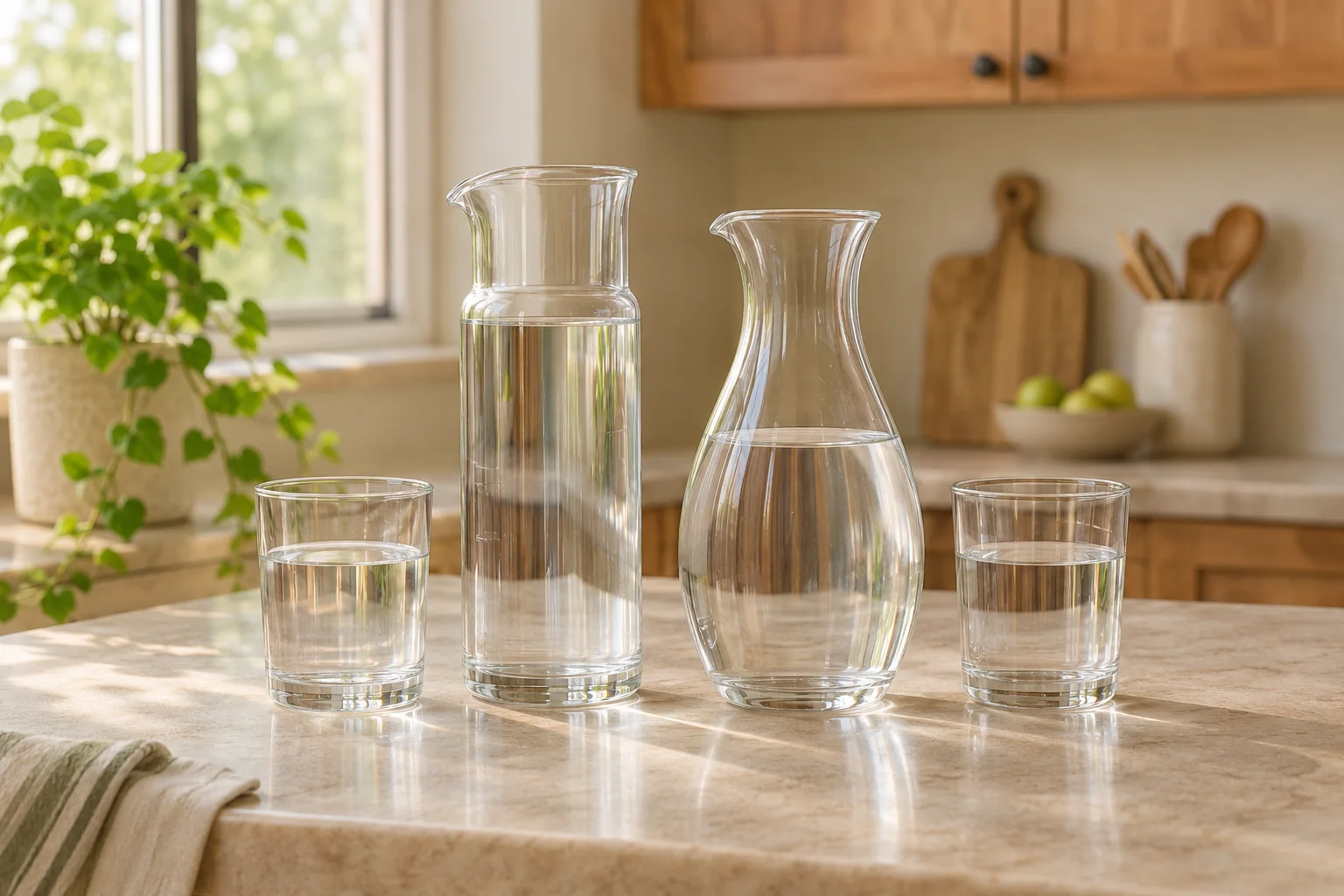
Distilled water is a type of purified water, but purified water is not necessarily distilled. Distillation describes a particular process: boiling water, collecting its vapor, and condensing that vapor into a separate container. Other purification methods include reverse osmosis and deionization. [1] [2]
That difference matters when you are reading a bottle label, choosing a home water system, or filling an appliance that specifies distilled water. Two glasses can look identical while the treatment methods and remaining mineral content differ.
Is purified water the same as distilled water?
The terms overlap, but they do not mean exactly the same thing. Purified water is the broader category; distilled water identifies how the water was treated.
Under U.S. bottled-water rules, water produced by distillation, deionization, reverse osmosis, or another suitable process can be labeled purified water when it meets the specified purified-water standard. A bottle may instead identify the process, such as distilled water or reverse osmosis water. [1]
So a jug labeled “purified” may contain water made by distillation, but the word alone does not establish that. Check the treatment information on the label.
Purified vs. distilled water: a quick comparison
| Comparison | Purified water | Distilled water |
|---|---|---|
| What the term means | A broader bottled-water category tied to treatment and a specified quality standard. | Water produced by distillation; one type of purified water. |
| How it is made | May use reverse osmosis, deionization, distillation, or another suitable process. | Water is boiled; its vapor is collected and condensed separately. |
| Mineral content | Depends on the process and any ingredients added after treatment. Do not assume minerals are retained. | Very low mineral content because most dissolved minerals remain behind. |
| Treatment limitations | Depend on the method and exact system. A broad label does not establish every reduction claim. | Some volatile chemicals can carry over. Equipment care and storage still matter. |
| Drinking and cooking | Choose a product intended for drinking and suitable for your water-quality needs. | Drinking-water products can be used for consumption; the process name is not a universal health ranking. |
| Appliance substitution | A generic purified label does not establish that it meets a distilled-water instruction. | Use when the exact appliance instructions specify distilled water. |
| What to check | Treatment method, added ingredients, intended use, and system performance information. | Distilled label, intended use, and the appliance or treatment-system instructions. |
On a smaller screen, swipe across the comparison to see all columns.
What is purified water?
For bottled drinking water, “purified” is a defined label associated with treatment and a quality standard. It does not identify one exclusive machine or process. [1]
Two methods you may see alongside distillation are:
- Reverse osmosis, or RO: pressure moves water through a membrane that reduces dissolved substances. Home systems may include additional filters before or after the membrane.
- Deionization: a process used to remove dissolved ions. It is another recognized route to purified bottled water when the required standard is met.
FDA describes both distillation and reverse osmosis as methods that remove minerals. It is therefore misleading to assume purified water always keeps its original calcium and magnesium. [2]
At home, look beyond a general promise of “purification.” Check the exact system, cartridge, certified reduction claims, and source-water requirements. A product description and the regulated label on a finished bottle of water serve different purposes. [8]
For examples of different home formats, our Frizzlife Water Systems Review distinguishes the brand’s RO systems from its other filters.
What is distilled water?
Distillation heats water until it becomes vapor, then cools and collects the vapor as liquid water in a separate container. Many dissolved substances remain behind rather than moving into the collected water. [2]
This is why distilled water has very low mineral content and is commonly specified for equipment where mineral deposits are a concern. However, distillation does not mean every possible contaminant has been removed.
CDC identifies limitations involving certain volatile organic compounds, volatile solvents, and pesticides. It also notes that distillation equipment needs care because bacteria can grow on cooling coils during periods of inactivity. [3]
Choose drinking water or an appropriately maintained treatment system for your intended use. Do not treat “distilled” as a promise that any source water, any machine, or any storage container will produce a suitable result.
Purified, filtered, and RO water: where do they fit?
Filtered water is not automatically distilled water
A pitcher, faucet filter, or portable filter can reduce particular substances without boiling water and collecting steam. “Filtered” tells you that a filtration step occurred; the device’s documented performance tells you what that step can accomplish. [3] [8]
Do not assume that a familiar filter format removes all dissolved minerals or produces the water your appliance requires. Our water filter pitcher guide compares refillable options and the details to check.
Reverse osmosis water is not distilled water
RO uses a membrane rather than evaporation and condensation. Both methods can reduce mineral content, but they work differently. The presence of an RO membrane also does not establish every contaminant-reduction claim for a particular system. [2] [3]
If you are considering countertop RO for daily drinking water, compare our Waterdrop N1 review and Waterdrop A1 review. Evaluate the exact model’s maintenance and dispensing features alongside its treatment claims.
Neither an RO label nor a low-mineral description is, by itself, permission to substitute that water in equipment whose instructions specify distilled water.
Which is better for drinking and cooking?
Start with water intended for drinking and suitable for the water-quality concerns you need to address. FDA regulates bottled water intended for human consumption; “distilled” and “purified” are not, by themselves, a ranking of which water is healthiest. [1] [2]
For everyday drinking and cooking, compare the following:
- Water quality: check your utility’s water-quality report or arrange appropriate testing when you have a specific concern.
- Treatment performance: match the system’s documented reductions to that concern.
- Taste and ingredients: check the treatment method and any ingredients added after treatment, then choose a taste you enjoy.
- Daily upkeep: consider refilling, cleaning, cartridge changes, and storage.
NSF explains that added ingredients must be stated on bottled-water labels. If minerals or electrolytes have been added, take that into account when comparing products or choosing water for a particular use. [4]
A home treatment system may not be necessary if your tap water does not contain harmful germs or chemicals. When treatment is useful, choosing it around a specific concern is more informative than choosing the most reassuring-sounding label. [3]
Our Best Water Filters guide compares practical home formats, while our Waterdrop Water Filters Review explores options within one brand.
Can you use purified water instead of distilled water in appliances?
If the manual specifies distilled water, use water labeled distilled unless the manufacturer explicitly permits an alternative. A bottle labeled only “purified” does not tell you enough to confirm the substitution.
The concern is often the minerals left behind as water is used or evaporates. However, requirements differ by appliance, so a recommendation for one device should not become a rule for every humidifier, steamer, or iron.
Humidifiers
EPA recommends water with low mineral content to reduce scale and mineral dispersal in the air. For ultrasonic and impeller humidifiers, it specifically discusses using bottled water labeled distilled. It also explains that purified water may be made by several different processes. [5]
Using suitable water does not replace cleaning. EPA recommends emptying portable humidifier tanks, drying their surfaces, and refilling them daily, along with following the equipment’s cleaning instructions. [5]
CPAP humidifiers
Check the instructions for your machine and its exact water tub. For example, the U.S. ResMed AirSense 11 guide specifies distilled water for the HumidAir 11 Standard tub but permits potable drinking-quality water for the Cleanable tub. [6]
That distinction is why general claims such as “all purified water is fine for CPAP” are unhelpful. Follow the equipment-specific instructions rather than treating the labels as interchangeable.
Steamers, irons, and other equipment
Read the water-type instructions for the exact model. If a particular type or mixture is specified, follow it; do not assume every appliance benefits from the same water. Water sold for drinking, water sold for technical uses, and a manufacturer’s required water specification are separate considerations.
Two other distinctions worth knowing
Boiled water is not the same as distilled water
Boiling a pot of water and letting it cool does not collect the vapor in a separate container. The dissolved minerals remain in the pot. EPA also cautions that boiling or disinfecting does not remove contaminants such as heavy metals, salts, and most chemicals. [7]
Boiling can be an appropriate response to certain germ-related advisories, but follow the actual advisory. It is not a general way to make chemically contaminated water safe.
Softened water is not distilled water
A conventional softener reduces hardness through ion exchange. Distillation uses evaporation and condensation. Reducing hardness is therefore different from producing distilled water or addressing every drinking-water concern. [3]
Our water softener vs. water filter guide explains that distinction and when separate treatment systems may serve different jobs.
How to choose the right water
- Decide what it is for. Drinking and cooking call for suitable drinking water. Appliances call for the specification in their instructions.
- Read the label or performance information. Look for the treatment method, intended use, and any added ingredients. For a home system, check the exact model’s reduction claims.
- Plan for upkeep. Store water in appropriate clean containers and follow the treatment system’s or appliance’s cleaning and replacement instructions.
There is no need to choose a home system simply because one label sounds purer. Review your water information first, then compare equipment that addresses the concern you actually have. [8]
Purified vs. distilled water FAQs
Can you drink distilled water?
Distilled water sold as drinking water is intended for human consumption. Choose a product labeled for that use, rather than assuming a container sold for laboratory or technical purposes is a drinking-water product. Its low mineral content does not, by itself, establish that it is the best choice for every person. [1] [2]
Is bottled water distilled?
Some bottled water is distilled; much of it is not. Look for “distilled” or treatment information on the label. “Purified” alone can describe water produced by other suitable methods, including reverse osmosis. [1]
Does a water filter pitcher make distilled water?
No. A filter pitcher does not boil water, collect the vapor, and condense it into a separate container. Check the cartridge’s specific claims to understand what it reduces.
Does purified water still have minerals?
The answer depends on the treatment process and any ingredients added afterward. Distillation and reverse osmosis remove minerals, so purified water should not automatically be described as mineral-rich. Check the label and manufacturer’s information. [2] [4]
Can purified water replace distilled water in a humidifier?
Do not assume that it can. Follow your model’s instructions and check how the water was treated. EPA discusses bottled distilled water as a low-mineral option for ultrasonic and impeller humidifiers; the general word “purified” does not establish the same process. [5]
Is distilled water automatically sterile?
No. “Distilled” describes a treatment process. U.S. bottled-water rules treat “sterile water” as a separate designation with its own requirement. Handling and storage after treatment also matter. [1]
Choose for the job the water needs to do
For drinking and cooking, choose suitable drinking water and a treatment method matched to your actual concerns. For equipment that specifies distilled water, check for that label and follow the manual.
The useful distinction is straightforward: distilled water identifies a particular purification process; purified water does not necessarily identify that same process.
Explore our water filter buying guide →
We may earn a commission when you buy through links on our site.
Research behind this article
- Electronic Code of Federal Regulations. 21 CFR 165.110: Bottled water, including purified-water and sterile-water labeling.
- U.S. Food and Drug Administration. Bottled Water Everywhere: Keeping It Safe.
- Centers for Disease Control and Prevention. About Home Water Treatment Systems.
- NSF. Bottled Water, including treatment methods and labeling of added ingredients.
- U.S. Environmental Protection Agency. Use and Care of Home Humidifiers.
- ResMed. AirSense 11 User Guide, Americas edition, water-tub setup and cleaning instructions.
- U.S. Environmental Protection Agency. Emergency Disinfection of Drinking Water.
- Centers for Disease Control and Prevention. About Choosing Home Water Filters.