
WATER PURIFIER REVIEW
AquaTru Review
Carafe, Classic or Under Sink? We compare AquaTru’s filtration, daily upkeep and ownership costs to help you choose.
By KitchLit · Updated November 16, 2026
Research-based review. We may earn a commission when you buy through our links.
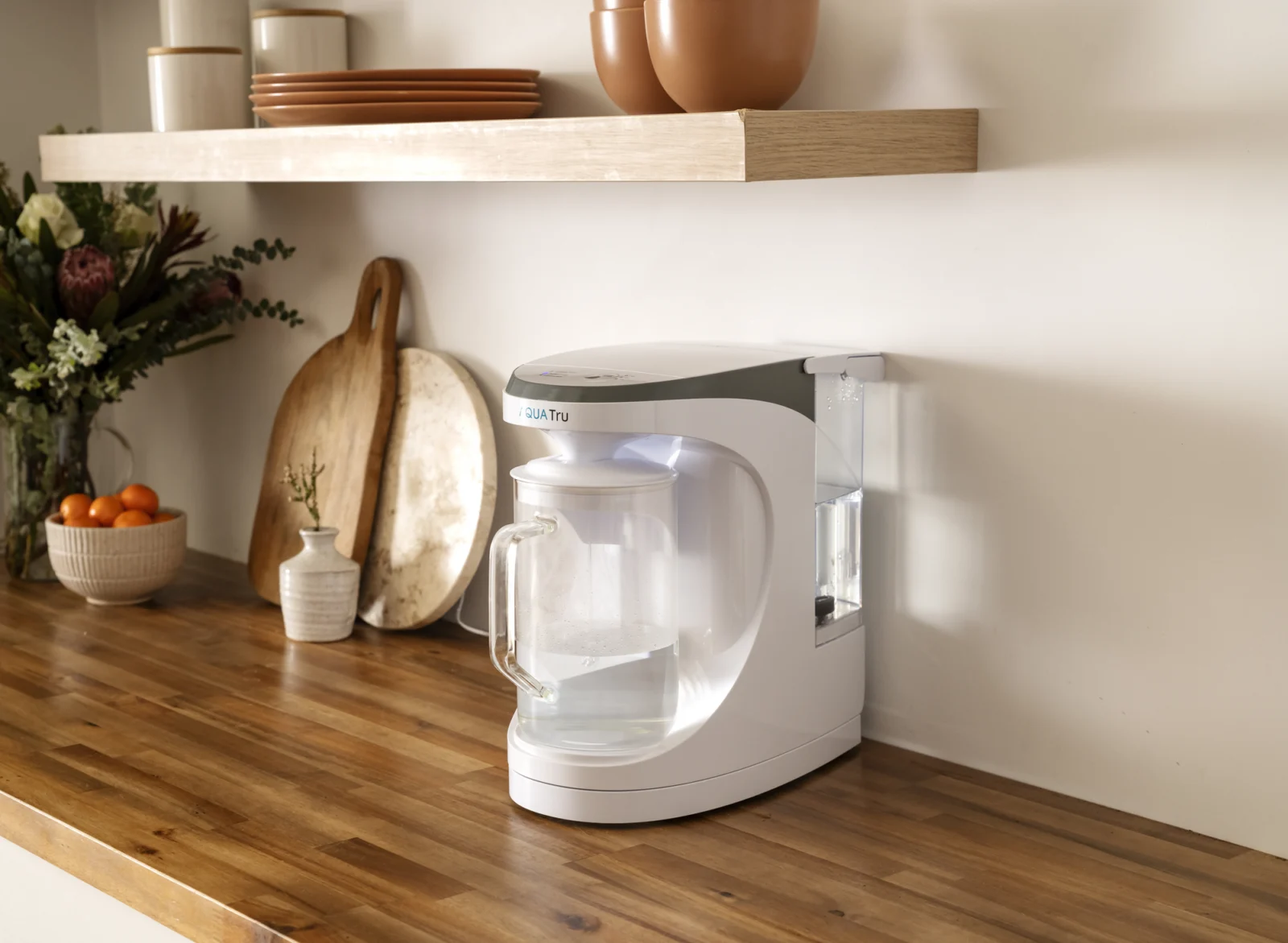
Key takeaways
1
Choose the format first
Carafe serves in glass, Classic holds more water on the counter, and Under Sink supplies a dedicated faucet.
2
Check the exact model
AquaTru publishes model-specific performance sheets. Filter capacities and water efficiency differ across the range.
3
Budget for the routine
The purchase price is only the start. Allow for filter changes, cleaning, reject water and any installation.
Is AquaTru worth it?
AquaTru is worth shortlisting when you want reverse osmosis for drinking water and are prepared to maintain it. Its appeal is the choice between two refillable countertop formats and an installed system, backed by published contaminant-reduction data.
For a smaller household that likes serving from glass, we would start with the Carafe. For more stored water without plumbing work, compare the Classic. The Under Sink makes more sense when a permanent faucet and automatic refilling matter more than a quick setup.
A simpler dispenser may be the better buy if your main concern is taste and its documented filtration meets your needs. Choose around your water and daily use, rather than the largest number on a contaminant list.
What we like
- Countertop choices avoid permanent plumbing changes.
- The Carafe has a removable glass serving vessel.
- Model-specific performance sheets make claims easier to check.
- An installed option keeps the main equipment off the counter.
What to weigh
- Countertop units still need refilling, tank care and electricity.
- All three systems produce concentrated reject water.
- Filters have time and gallon limits, with different ratings by model.
- Hard water and installation conditions can affect suitability.
Carafe vs. Classic vs. Under Sink
The biggest practical difference is how water reaches your glass. Use the comparison to narrow the format before paying extra for a Smart model or an alkaline finishing filter.
| Buying factor | Carafe | Classic | Under Sink Gen 2 |
|---|---|---|---|
| Best fit | Glass serving; smaller batches | A larger countertop reserve | A permanent drinking-water faucet |
| Format | Refillable countertop RO | Refillable countertop RO | Installed RO with holding tank |
| Purified-water storage | 64 oz / 0.5 gal / 1.9 L | 96 oz / 0.75 gal / 2.8 L | Up to 1.7 gal, manufacturer-listed |
| Space to measure | 7.5 W × 14 D × 13 H in | 12 W × 14 D × 14 H in | Manifold: 11 W × 4 D × 11 H in; tank: 10 in diameter × 14 H in |
| Setup | 120V outlet; no plumbing | 120V outlet; no plumbing | Water supply, drain and dedicated faucet; 40–85 psi feed pressure |
| Everyday task | Refill feed tank; empty concentrate; pour carafe | Refill feed tank; empty concentrate; dispense water | Service filters and sanitize system; no manual feed-tank refills |
Specifications checked November 16, 2026. Filter options and bundles can change. Measure access for tank removal or filter servicing as well as the listed footprint. Swipe across the table on smaller screens.
Which AquaTru would we choose?
Choose around your counter space, serving style and tolerance for refills. Then compare the exact model and filter bundle before ordering.
AquaTru Carafe
Our starting point for glass serving.
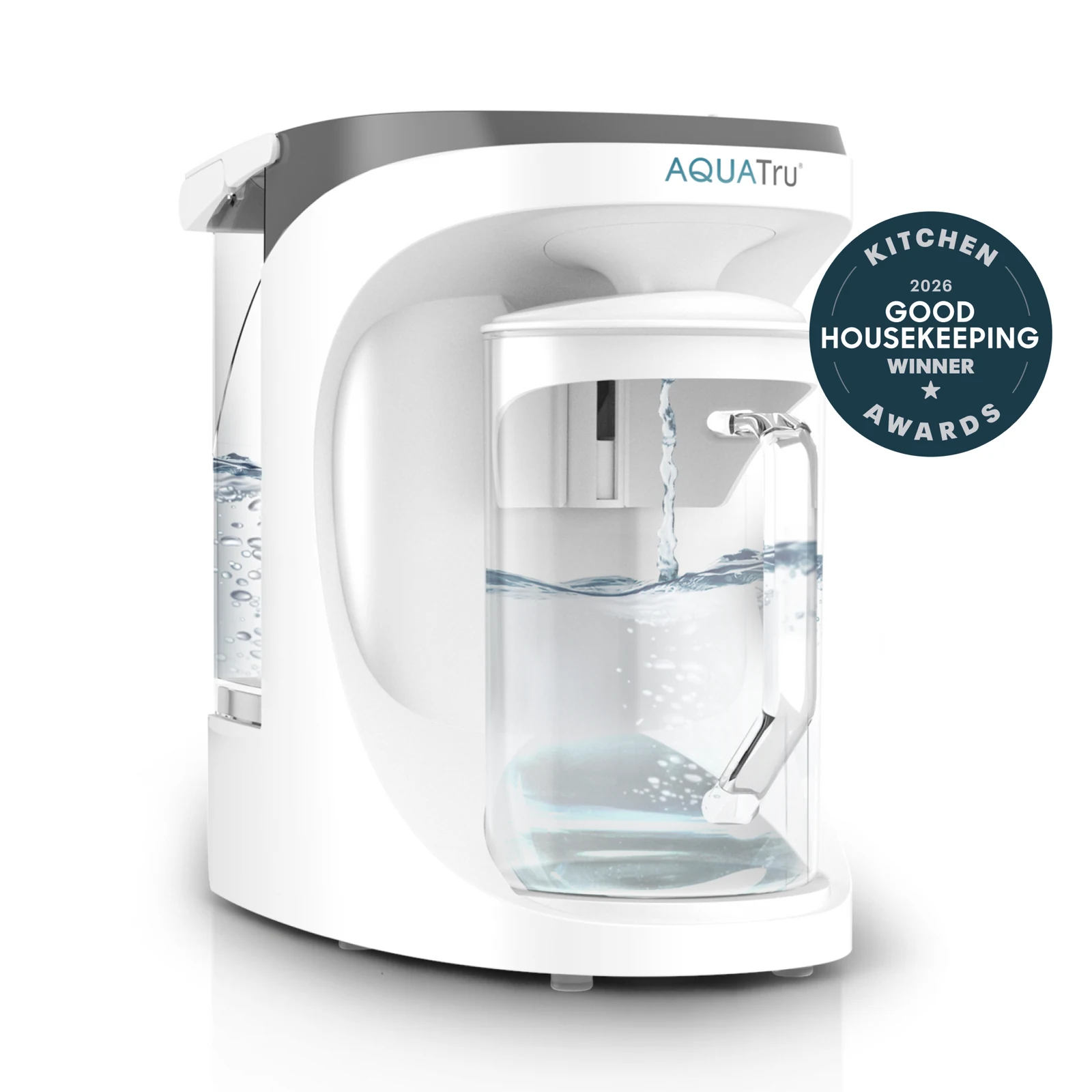
The 64-ounce borosilicate carafe can go from the purifier to the table or refrigerator. The narrower base is useful when counter width is limited.
Its smaller reserve is the compromise: if you use filtered water for bottles, coffee and cooking, expect more refill cycles. Choose it because the serving vessel suits your routine.
Best fit: Smaller batches and a removable glass pitcher.
AquaTru Classic
More stored water without plumbing.
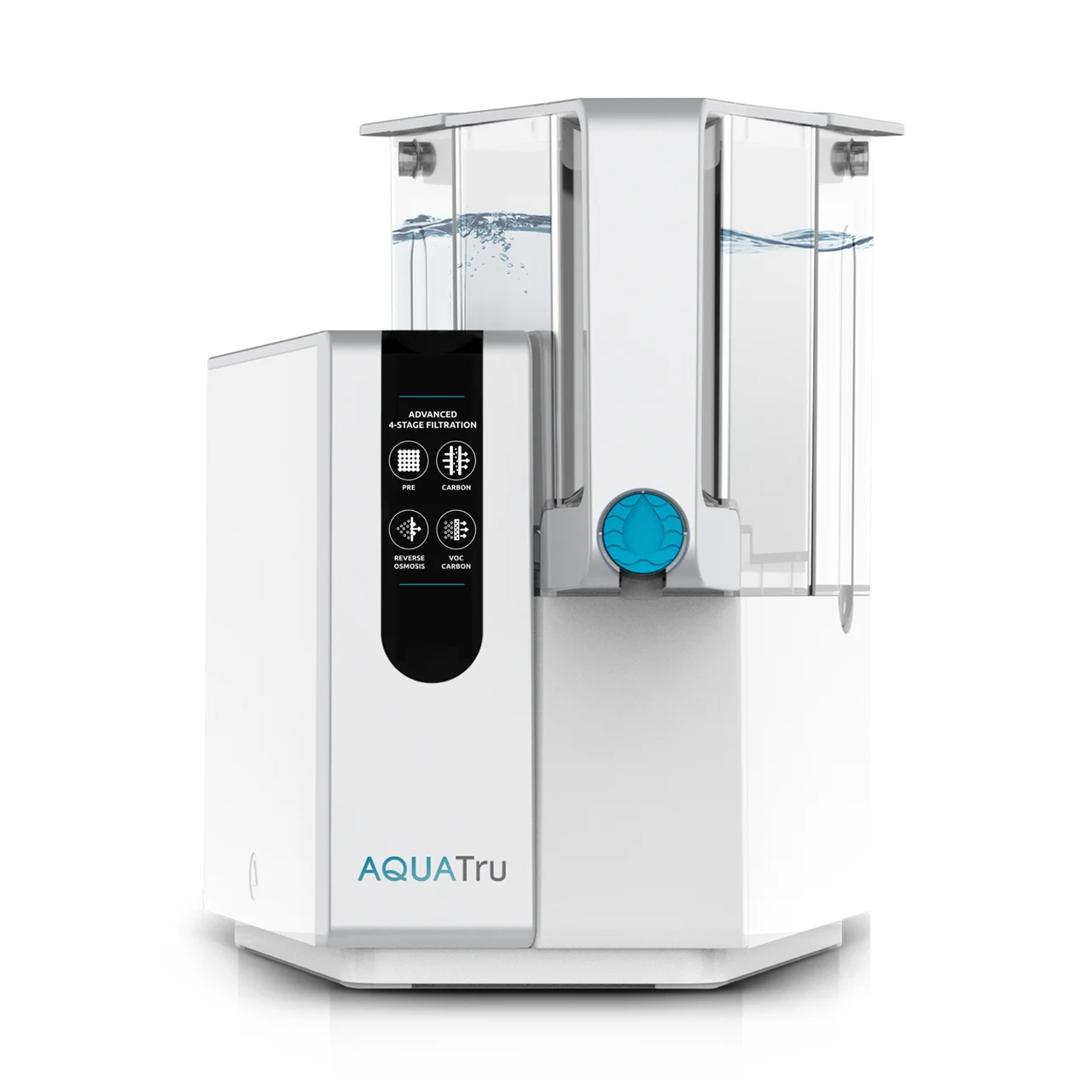
A 0.75-gallon purified-water tank gives the Classic a larger ready-to-use reserve than the Carafe. Water dispenses from the unit rather than a glass serving pitcher.
It needs more counter width and still uses a manually filled feed tank. We would favor it when fewer serving-water refills matter more than a compact footprint.
Best fit: A larger countertop drinking-water station.
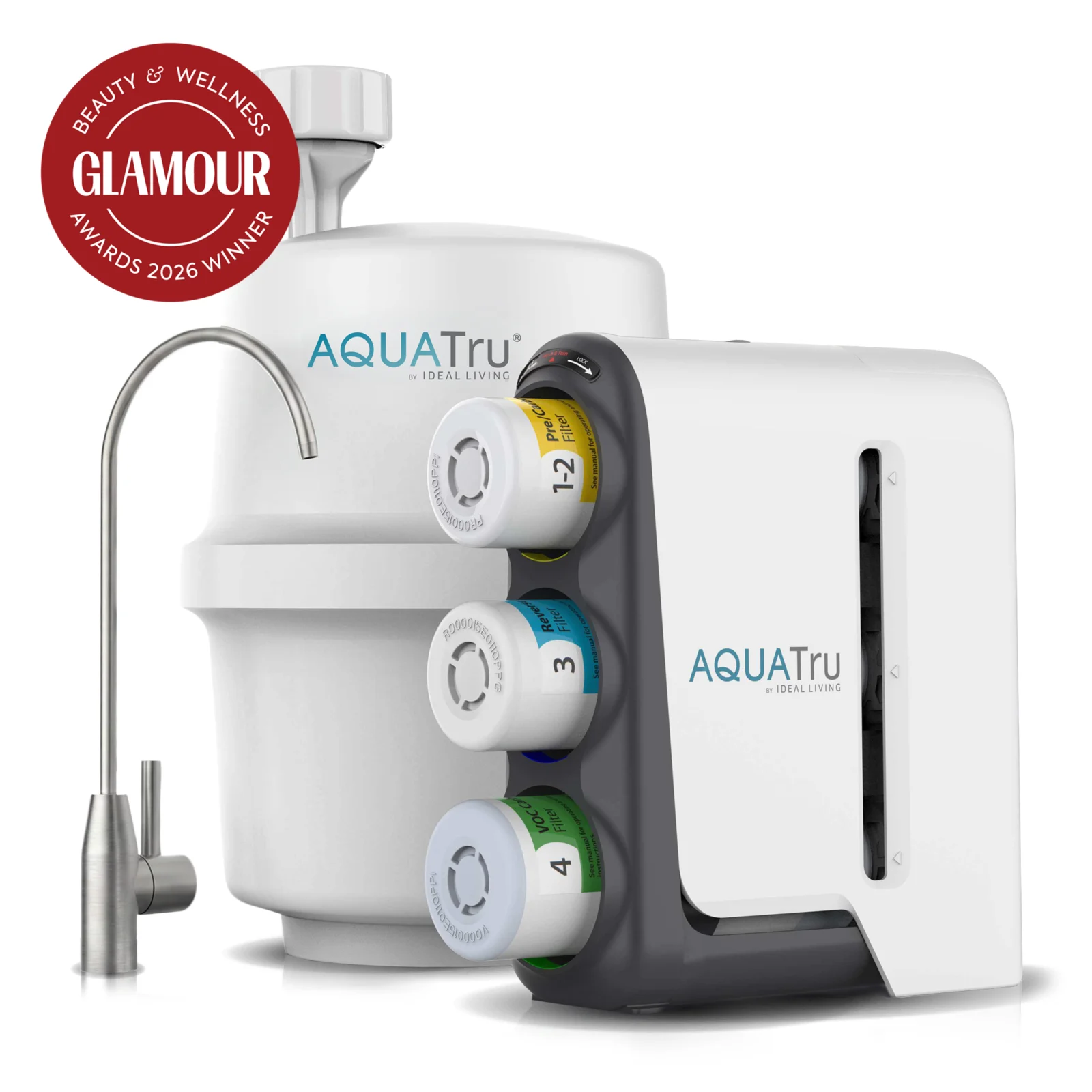
AquaTru Under Sink
A permanent faucet for daily use.
The current Gen 2 system puts the filters and holding tank in the cabinet. AquaTru lists up to 1.7 gallons of stored purified water, plus leak detection and a dedicated faucet.
Plan the water and drain connections, faucet position and filter access. The separate tank takes cabinet space, so compare the complete installed setup.
Best fit: A kitchen ready for an installed RO system.
What does AquaTru filter out?
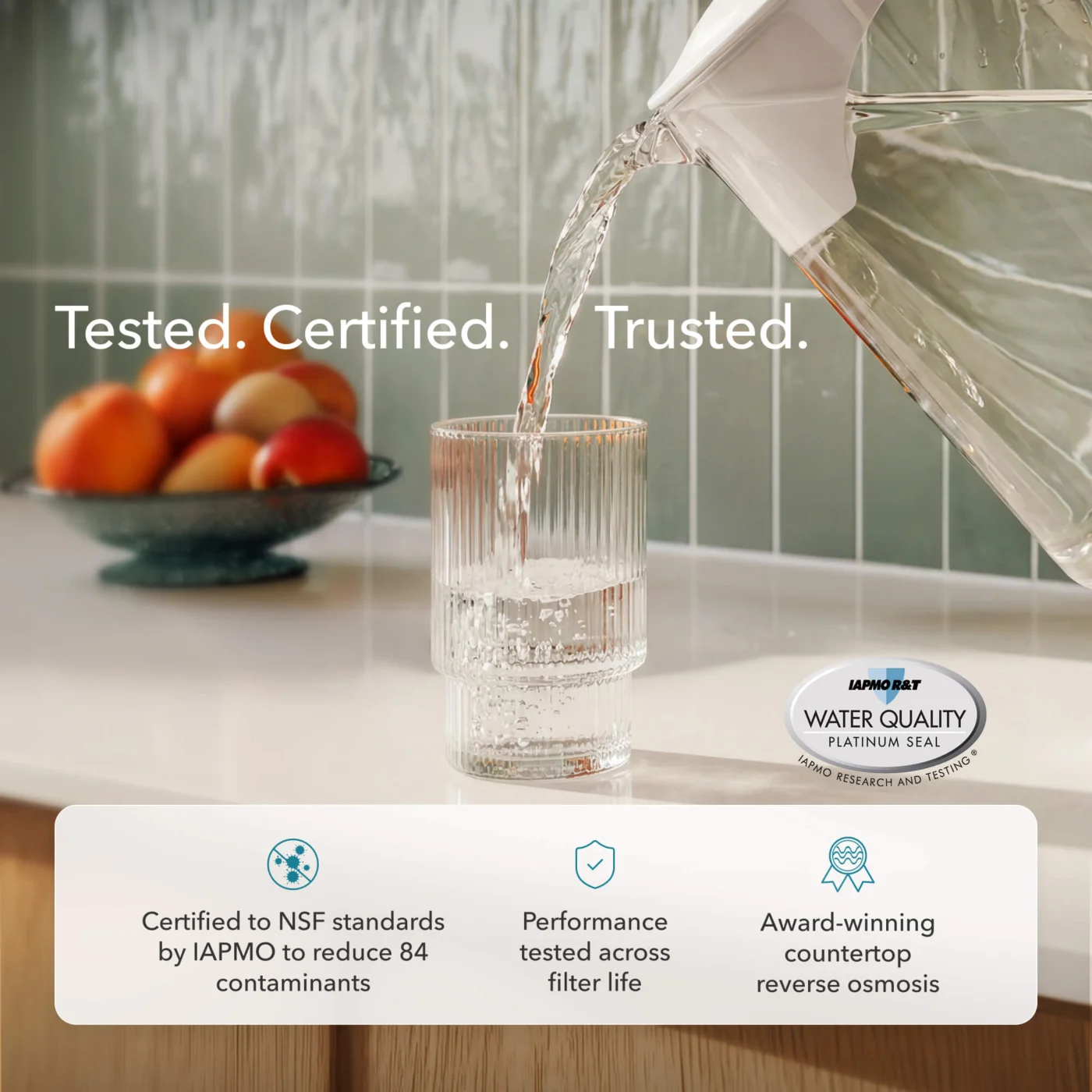
AquaTru describes its home purifiers as four-stage reverse-osmosis systems certified by IAPMO to applicable NSF/ANSI standards for 84 contaminant-reduction claims. Examples in the published sheets include lead, fluoride, certain PFAS and microplastics. Reduction results belong to the named system, cartridge and test conditions.
That is more useful evidence than a broad “pure water” promise. It does not mean every possible contaminant is removed, or that all three models have identical reduction percentages.
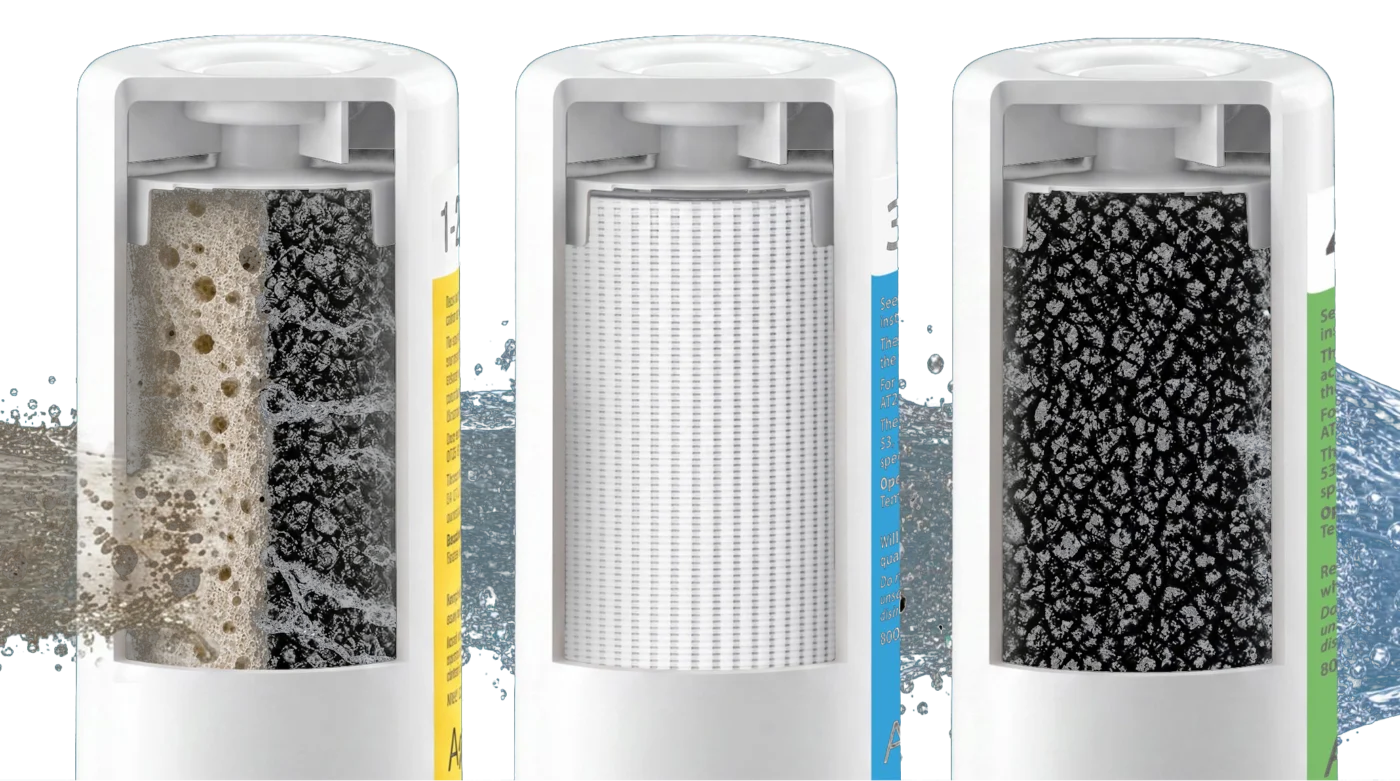
Four stages, three cartridges
- Pre/Carbon: combines initial particle filtration with carbon treatment before the membrane.
- Reverse osmosis: treats water through a membrane, reducing dissolved substances and creating a concentrate stream.
- VOC Carbon: provides the finishing stage. A compatible Mineral Boost version also adds minerals after RO.
The first cartridge combines two stages, which is why four-stage filtration uses three replaceable cartridges.
Read the certification precisely
The sheets reference NSF/ANSI 42, 53, 58 and 401 for specified performance claims. NSF/ANSI 372 concerns lead content in materials; it is not a claim that the filter removes lead.
IAPMO is the certifier identified in AquaTru’s documentation. Saying the systems meet NSF/ANSI standards is more precise than implying NSF itself issued the certification.
Match the sheet to the unit you are buying. The current Under Sink Gen 2 sheet identifies model ATU200.
The everyday tradeoffs to understand
Refilling and cleaning
Carafe and Classic simplify installation, but someone still has to fill the feed tank, empty the concentrated water left after a cycle and clean the removable parts. Do not keep topping up that leftover concentrate with fresh tap water.
Under Sink replaces this manual refill routine with installed plumbing. It still needs filter changes and sanitizing according to its instructions. Choose the format whose chores you are most likely to keep up with.
Reject water varies by model
The published sheets list efficiency ratings of 63% for Carafe, 75% for Classic and 25% for Under Sink Gen 2. These are laboratory ratings that approximate daily use, not results measured by KitchLit.
They describe the share of incoming water available as treated water under the stated conditions. Avoid applying one model’s water-saving claim to the entire range; actual use varies.
Hard water is a buying condition
The performance sheets advise against feed water above 10 grains per gallon, about 171 mg/L hardness, unless it is softened first. Scale can shorten membrane life. Check the full inlet-water limits, not just a TDS reading.
If scale is your main household problem, read our water softener vs. water filter guide. A drinking-water RO purifier does a different job from treating hardness throughout a home.
Purified is different from distilled
AquaTru uses reverse osmosis rather than boiling water and collecting the vapor. Standard RO treatment reduces dissolved minerals as well as targeted contaminants; Mineral Boost is an optional finishing choice.
Our purified vs. distilled water guide explains the terminology. For this purchase, focus on the model’s documented treatment and how you prefer the water to taste.
Replacement filters and ownership costs
Use whichever comes first: the time interval or the gallon limit. Carafe cartridges have lower gallon ratings than Classic cartridges. For Under Sink, the current Gen 2 performance sheet and the October 2026 support guidance specify 360 gallons for the Pre/Carbon and VOC filters.
| Filter | Carafe | Classic | Under Sink Gen 2 |
|---|---|---|---|
| Pre/Carbon | 6 months or 300 gal | 6 months or 600 gal | 6 months or 360 gal |
| VOC / Mineral Boost VOC | 12 months or 300 gal | 12 months or 600 gal | 12 months or 360 gal |
| RO membrane | 24 months or 600 gal | 24 months or 1,200 gal | 24 months or 1,200 gal |
Intervals checked against the current model performance sheets and support guidance. Older Under Sink pages also show 600-gallon figures; use the documentation supplied with your exact system. Water quality can shorten service life.
Plan for replacement filters
The standard Carafe and Classic one-year combo packs each contain two Pre/Carbon filters and one VOC filter. The RO membrane is separate.
Your purifier comes with initial filters. Plan future purchases around time and gallon limits, then include any descaling supplies, shipping and earlier replacements when comparing ongoing upkeep.
Compare the complete cart
Confirm the correct filter family before ordering: Carafe filters are specific to the compact model. Check compatibility and the stated replacement capacity for Under Sink instead of assuming the Classic schedule applies.
Compare a one-time purchase with any filter subscription offered at checkout. Subscriptions involve recurring shipments and charges; the lower displayed price may depend on that choice.
For Under Sink, add installation and ongoing sanitizing to the budget. Compare total ownership rather than judging the systems on their base prices alone.
Smart or Mineral Boost: are the upgrades useful?
Smart is a convenience upgrade
Carafe Smart and Classic Smart add app features such as filter-life tracking and replacement reminders. AquaTru describes the core purification as the same as the corresponding standard model.
Pay extra if reminders on your phone would help you maintain the system. We would choose the model size and serving format before deciding whether app access is worth the difference.
Mineral Boost changes the finish
The Alkaline Mineral Boost VOC option adds minerals after purification and raises pH. Choose it for your taste preference and the finishing filter you want to keep buying.
A higher pH alone does not establish better contaminant reduction. Compare the applicable performance sheet and replacement cost rather than treating “alkaline” as an automatic upgrade.
Warranty and returns
AquaTru’s published limited warranty is one year for qualifying defects in materials and workmanship. Filters are excluded, and warranty service can involve shipping and processing fees. Damage from misuse or missed maintenance is outside the stated coverage.
The direct-store return policy offers 30 days from delivery. Personal-preference returns can have shipping deducted from the refund, while defective, damaged or incorrect-item cases have different terms. Keep the packaging and confirm the applicable terms before ordering.
What else should you compare?
For other formats, our best water filters guide puts AquaTru Carafe alongside countertop, gravity and under-sink alternatives.
Explore the Waterdrop review for additional RO layouts, or our Culligan review for refillable dispensers and gravity systems. If a smaller non-powered vessel suits your needs, compare the water filter pitcher options.
This review focuses on the three home drinking-water systems. AquaTru also sells shower products and a Freestanding business-oriented purifier; those serve different buying needs.
AquaTru questions, answered
Which AquaTru model is best?
Start with Carafe for a removable glass pitcher, Classic for a larger countertop reserve, or Under Sink for an installed faucet. Our choice depends on serving style, refill tolerance and available space, rather than one universal winner.
Does AquaTru remove fluoride, PFAS and microplastics?
The model-specific performance sheets include fluoride, named PFAS such as PFOA and PFOS, and microplastic reduction claims. Check the exact system’s listed reductions and conditions. A claim for selected PFAS is not a promise to remove every PFAS compound.
Can AquaTru handle hard water or untreated well water?
The performance sheets recommend softening feed water above 10 gpg hardness before using the RO system. Do not treat the purifier as a standalone solution for water of unknown microbiological quality. Well-water suitability needs to be checked against testing and the exact inlet-water requirements.
Does every AquaTru need plumbing?
No. Carafe and Classic use refillable tanks and require an electrical outlet. Under Sink connects to the water supply and drain and uses a dedicated faucet.
Do all AquaTru models use the same filters?
No. Carafe uses its own cartridge family. Classic and Under Sink filter listings can overlap, but replacement capacities differ. Match the cartridge and schedule to the model and generation you own.
Is AquaTru water distilled?
No. AquaTru uses reverse osmosis. Distillation uses evaporation and condensation. Both can be purification methods, but they are different processes; see our purified vs. distilled water guide.
Choose the system you will keep using.
Our starting choice is the Carafe when glass serving and a compact countertop setup are the priorities. Step up to Classic for more stored water without plumbing, or choose Under Sink when a permanent faucet is worth the installation.
AquaTru’s published performance documentation makes the range worth comparing. The buying decision still comes down to your feed water, refill routine, space and replacement budget. Price the model and filter option you actually want, then confirm the complete offer.